Weird Fishes
“Weird Fishes” by Sahana Ramakrishnan at Rajiv Menon Contemporary
Feb 25 - April 4 2026
1311 Highland Ave, Los Angeles, CA 90028
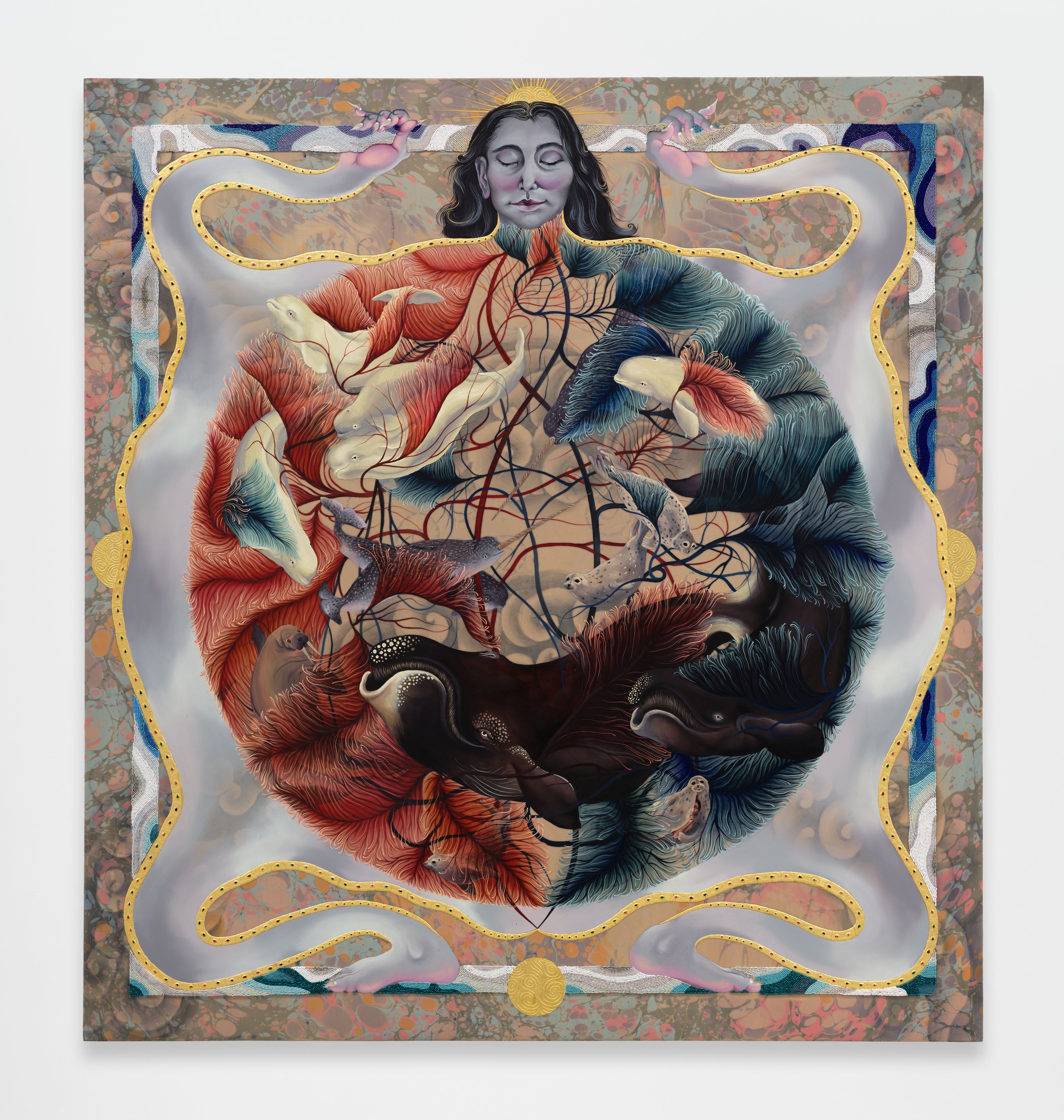
Sahana Ramakrishnan’s new paintings and sculpture at Rajiv Menon Contemporary dance upon the thresholds between worlds. Across canvases and painted panels, the exhibition weaves folklore and field research shaped by recent travels in the Arctic Circle. Ramakrishnan’s palette is anything but frigid, yet her works ruminate on the ocean as an enigmatic underworld. As mythology insists, such realms are not devoid of life, but they are bound to different laws, and largely sealed from the perceptions of the living. In polar Norway, Ramakrishnan listened via hydrophones through glacial ice to the songs of belugas, seals, and narwhals, drawn toward a dimension that was close enough to hear, but impossible to inhabit.
Mammals and fish recur as emblems of evolutionary divergence and figures of magical crossover. In Selkie, a human soul pulses inside the body of an Arctic seal, suggesting that shapeshifting may be a psychic event, or a form of yearning. While northern folklore casts selkies as seducers who draw humans to watery graves, Ramakrishnan frames the lure as reciprocal: in Seduction of the Sea Queen, a siren’s voluptuous fins signal not only erotic power, but a hunger for something beyond her element. In The Death of Venus, Botticelli’s sea-born goddess of love is returned to the ocean and devoured by fishes, crossing out of iconography and into the food chain. More cosmology than tragedy, the scene affirms that even divinity surrenders to cycles of transformation. Dissolution is also a form of becoming—and beauty is granted no exception.
The show’s centerpiece, The Magic Flower, takes the form of a kavad, an illustrated wooden storytelling box whose narrative unfolds as successive doors are opened. Inside blooms an original tale of love and crossings: two lovers find a flower so beautiful that it ignites passion, then catastrophe—for inside the blossom waits a heavenly force of change, one that must lead desire through death’s portal. The kavad suggests depth over linear progress, moving deeper into story and image, across thresholds that cannot be crossed in ordinary time. For Ramakrishnan, whose practice is characterized by material and symbolic layering, the form becomes a vehicle for journeying into underworlds, submerging us in the recognition of our own unending transformations.
— Alex Ardyce Jones